
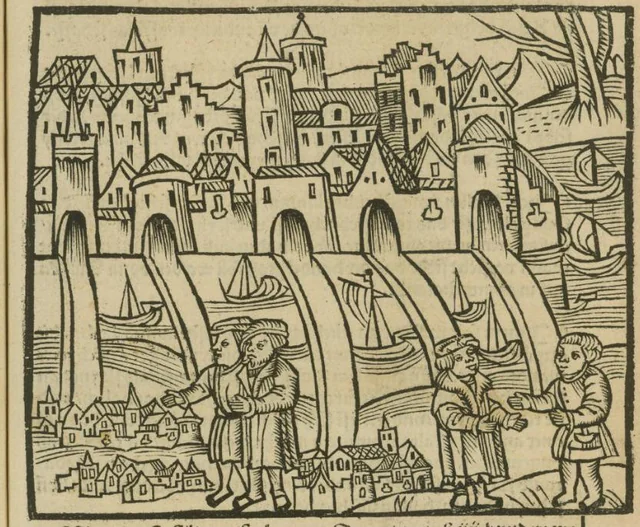
It’s a shame that the ruins of this once great city called Great Venice (not Little Venice. Very interesting.) by the arriving Spaniards, is now buried below modern Mexico City.

“The pamphlet described Tenochtitlan in concrete detail, emphasizing its qualities of urban order and government. Tenochtitlan, here dubbed “Great Venice” in recognition of its splendor, was the most magnificent city encountered in the New World. It was constructed on islands in a mile-wide lake, with gated towers guarding each of its five bridges. Much like the European city-state of Venice, it had three smaller dependent cities on the surrounding land. The aptness of Aztec Great Venice’s comparison to one of the greatest cities in Europe continued. Canals of salty lake water ran through the city, but sweet drinking water was delivered via an impressively engineered aqueduct. Other aspects of architecture were impressive: each house had its own cistern, and the city’s temples were constructed like castles. The possibilities for trade and commerce in Great Venice were also emphasized by the German translators. The numbers of people visiting its marketplace were provided (the given figure was lower than Cortés’s by 10,000). Like other cities of Mexico, it had city council halls and a central market plaza where everything was bought and sold. Weights and measures were used to calculate sales. The pamphlet provided further promising details. Trade, it declared, seemed organized with the aid of merchant account books. Explicitly in contrast to other Mexican cities, which used cacao beans as currency, the pamphlet reported that Great Venice used metal currency in the form of copper coins. Although in reality this claim lacked foundation, the German reader would not have any reason to question this additional sign of civilization. This pamphlet also represented these civilized attributes through a new image of the capital city Tenochtitlan.
In the image, signs of cultural sophistication abound. The city is depicted as a European city (Figure 2). Five bridges are visible with their protective turrets, the surrounding lake is filled with ships, three outlying towns edge the lake. Instead of the wooden and thatch huts shown as dwellings in earlier images of the Indies, these towns are solidly-built equivalents to European cities. Architecture as a marker of civilization and culture was increasingly emphasized in European thinking, and this image reinforces the text’s assertion of urban accomplishment. The people of Tenochtitlan demonstrate that they are civilized rather than wild through their clothing, as well. They are not naked or wearing girdles of feathers. Rather, they are dressed as prosperous Europeans. In the foreground, the-peaceful action of the pamphlet is illustrated. To the right, Cortés and Moctezuma meet. Moctezuma wears the robes of a wealthy, high-ranking person: electors and urban patricians of the Holy Roman Empire often wore similar fur-collared clothing in portraits. To the center of the foreground, Moctezuma and Cortés walk together through the city.” – Johnson, Carina L. Cultural hierarchy in sixteenth-century Europe : the Ottomans and Mexicans. Cambridge University Press, 2014.”
Leave a Reply